
Overview
We don’t have a mental health crisis in the workplace. We have a measurement crisis. Because right now, most organisations are asking: “How engaged are our employees?” or “How stressed are our teams?” But almost no one is asking: “Which specific skills are driving-or limiting-employee wellbeing?" And that’s the gap. Because if you can’t measure the skill, you can’t develop it. And if you can’t develop it, you can’t scale wellbeing.
Over the past 3 years at the Flourishing Labs, we’ve analysed quantitative and qualitative data from 8,500 employees across multiple organisations using our PERMA-V Wellbeing Skills Discovery.
We Tracked:
60 discrete skills from our Wellbeing Skills Competency Model
Across all of Martin Seligman’s scientific Wellbeing Pathways: Positivity, Engagement, Relationships, Meaning, Achievement, and Vitality
And mapped their impact on life satisfaction, resilience, performance, and retention.
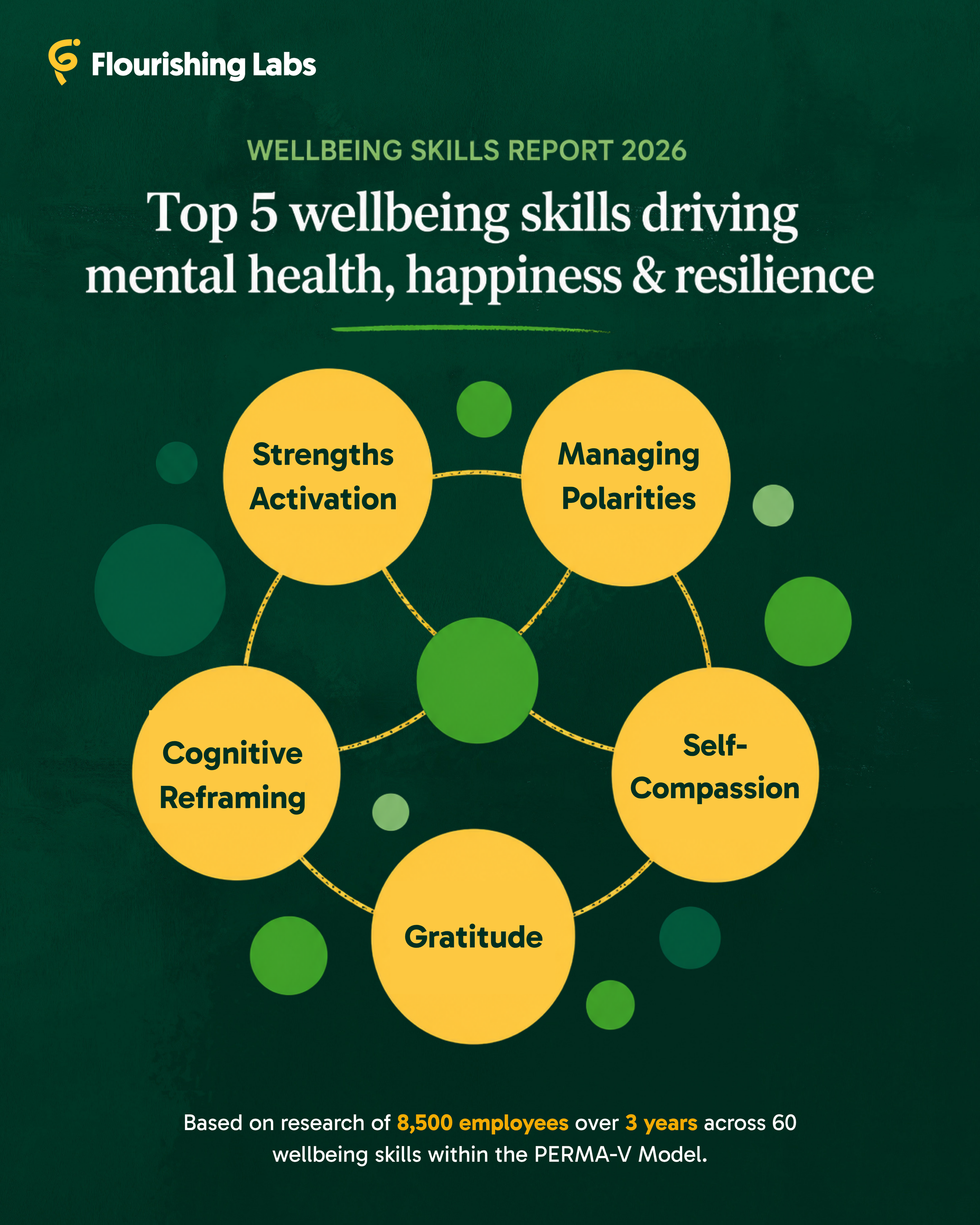
And what we found changes how we approach workplace wellbeing entirely. Out of 60 wellbeing skills, just 5 account for nearly half of employee wellbeing outcomes. Not perks. Not policies. Not pay. Wellbeing skills.
Top 5 Wellbeing Skills of 2026
1. Strengths Activation
(r = 0.571, β = +1.23, p < 0.001)
The wellbeing skill that had the highest correlation with life satisfaction is strengths activation. It’s the ability to connect deeply and intentionally use your core values and signature strengths—not just at work, but across your whole life.
Tarnia, a lawyer shared:
“I’m a lawyer—but my real strengths are kindness, appreciation for beauty, and spirituality. So on the side, I create art that sparks positivity, connection and transcendence.”
What’s surprising in what the qualitative and quantitative date is saying is that people’s wellbeing don’t come from their job title or career success. It comes from expressing who they really are—even outside her job description. And that tells us something important: People don’t burn out because they lack capability. They burn out because they lack an outlet to manifest their values and strengths.
In your organisation, are people truly using their strengths, or are they just performing roles that ignore who they are?
2. Managing Polarities
(r = 0.515, β = +1.12, p < 0.001)
The second wellbeing skill that differentiated the happiest employees is managing polarities. It’s your ability to navigate tensions that don’t have a single solution. Things that look like polar opposites - like stability and change, AI efficiency vs human connection, global standards vs local relevance. Instead of choosing one, you learn to move between both.
Dawn Joseph, a Head of Training, shared,
“These are interesting times—things are either changing completely or completely stuck. But I’m enjoying dancing between experimentation and staying grounded.”
What’s surprising in what the data is saying is that uncertainty isn’t something the most resilient employees are trying to eliminate. They’re actually engaging with it. And that’s a shift. Because resilience isn’t about controlling the environment—it’s about becoming more adaptive within it.
Do the leaders in your organisation have a tendency to force people to choose between opposing poles? Like AI efficiency, or human connection? Global standards or local relevance? Or are they helping them learn how both can co-exist?
3. Cognitive Reframing
(r = 0.472, β = +0.99, p < 0.001)
The third wellbeing skill that sets apart employees with the highest mental health is cognitive reframing. It’s your ability yo reinterpret challenges in a way that expands possibility. Not denying difficulty—but changing the meaning you assign to it.
Andre, a Credit Risk Director, said:
“This level of change is demanding more of me—and that’s where my next level comes from.”
What’s surprising here is that employees that have the highest levels of mental health doesn’t see pressure as a threat. It’s seen as an invitation to grow. And that’s powerful. Because the future stops being something that happens to you…and becomes something you actively step into.
In your organisation, when people feel stuck, are colleagues just working together to go from -10 to zero? Or are they challenging each other to imagine what +10,000 could look like?
4. Self-Compassion
(r = 0.469, β = +0.79, p < 0.001)
The 4th wellbeing skill that led to greater life satisfaction is self-compassion. It’s your ability to relate to yourself with kindness—especially in moments of struggle. Not self-criticism or perfectionism, but humanity.
Kush, an Analytics Manager, said:
“I’m allowed to be human in a complex world.”
What’s surprising here is how simple that sounds. But for many people, that belief is completely absent. And without it, every mistake becomes a personal failure. With it, challenge becomes something you can move through—not something that defines you.
In your workplace culture, is it safe for people to fail, or are mistakes something people feel they have to hide?
5. Gratitude
(r = 0.444, β = +0.88, p < 0.01)
Lastly, the 5th key wellbeing skill is gratitude. It’s your ability to intentionally notice and appreciate what is going well—especially in difficult contexts.
Akshit, a Data Scientist, shared:
“Sometimes I look at my newsfeed and want to throw my phone off the balcony.
But then I notice my happy workmates, the trees in the Park outside my work office, the sunset in my view…and I realise that, actually, I’m blessed 99.9% of the time.”
What’s surprising here is not that the happiest employee’s lives are perfect. It’s that they’re training his attention deliberately. Because what we focus on… expands. And in a world designed to amplify threat—gratitude becomes a way to rebalance perception.
Are you a leader that’s helping people to notice what’s good more often than what’s not working?
These aren’t abstract ideas. These are skills in action—lived, practiced, and embodied.
Summary
In 2011, at the American Psychological Association’s Annual Conference, Martin Seligman, the Father of Positive Psychology, set a moonshot goal for all humanity: 51% of the world flourishing by 2051. At the Flourishing Labs, we’re working to make that real through our work with Positive Organisations.
But here’s the challenge: Most organisations are investing my programmes, platforms, benefits. But very few are investing in the specific skills that drive wellbeing outcomes. That’s exactly why we built the PERMA-V Wellbeing Skills Discovery. A diagnostic tool that:
Measure all 60 wellbeing skills
Identifies the skills gaps at individual, team, and organisational level
Links directly to targeted interventions
So instead of asking: “Are people struggling?” You can ask: “Which skills are missing—and how do we build them?”
In this article, I’ve shown you the top 5. But behind this is a full dataset of 60 measurable wellbeing skills. If you’re a Head of Wellbeing, Engagement or L&D thinking:
“How do we measure wellbeing properly?”
“How do we move beyond engagement surveys?”
“How do we target interventions that actually work?”
Then I’d invite you to book a meeting with us. We’ll walk you through the full Wellbeing Skills Report 2026, your organisations potential skills gaps, and how to apply the key insights from the report in your workforce immediately.
Because the future of workplace wellbeing is not more content, it’s better diagnostics. Not more initiatives, but more precision. And the organisations that win in the next decade won’t be the ones who care the most about wellbeing, they’ll be the ones who know exactly how to build it through data-driven upskilling & empowerment.
Jill Heins
Head of Wellbeing Consulting
Join us at Wellbeing at Work London Summit 2026!
This year, we are excited to be speakers and exhibitors at the upcoming Wellbeing at Work Summit on September 15. What you can expect:
Jill Heins, our Head of Wellbeing Consulting will be running a hosted workshop on: “How to Achieve 2.4+ Million ROI for Your Wellbeing Programme” from 12:10 - 13:10.
Visit us at Booth 118:
Experience the new release of our Organisational Wellbeing Diagnostics Platform.
Get complementary access to an Executive Wellbeing Skills Assessment and Coaching across 60 wellbeing skills.
You can reserve your place for the workshop on the app: Apple Store | Google Play Store
We look forward to seeing you there!