
Scientific, practical, and preventative, it is the new paradigm for achieving peak mental health, happiness & resilience.
Overview
When I had an Anxiety & Panic Disorder (link) and two years of therapy failed me, I decided to take things into my own hands. I scoured the world for other models of mental health, psychology, or wellbeing. I was determined to understand what was broken with my brain and how I could fix it.
Providence came when I met Sam Levine, a Stanford Cognitive Neuroscientist who was my manager and coach at that time. His introduction to Positive Psychology transformed how I saw my potential for health & happiness.
WHAT is Positive Psychology?
Positive Psychology is the scientific study of mental wellbeing. Developed by Martin Seligman, then the head of the American Psychological Association in 1998, it sits within the broader umbrella of Psychology (everything to do with the mind). Positive Psychology is different from Clinical Psychology which treats mental illness; Humanistic Psychology which is less scientific; and Self-Help which gives lots of practical tips but is not scientific at all. Therefore Positive Psychology offers the best combination of empirical rigour and practical applicability for improving your mental wellbeing.
What this field of Psychology has done for me, which I hope it will do for you as well, is to broaden your horizon in terms of what’s you’re capable of achieving when it comes to your own mental health, happiness, and resilience.
WHY You Should Practice Positive Psychology
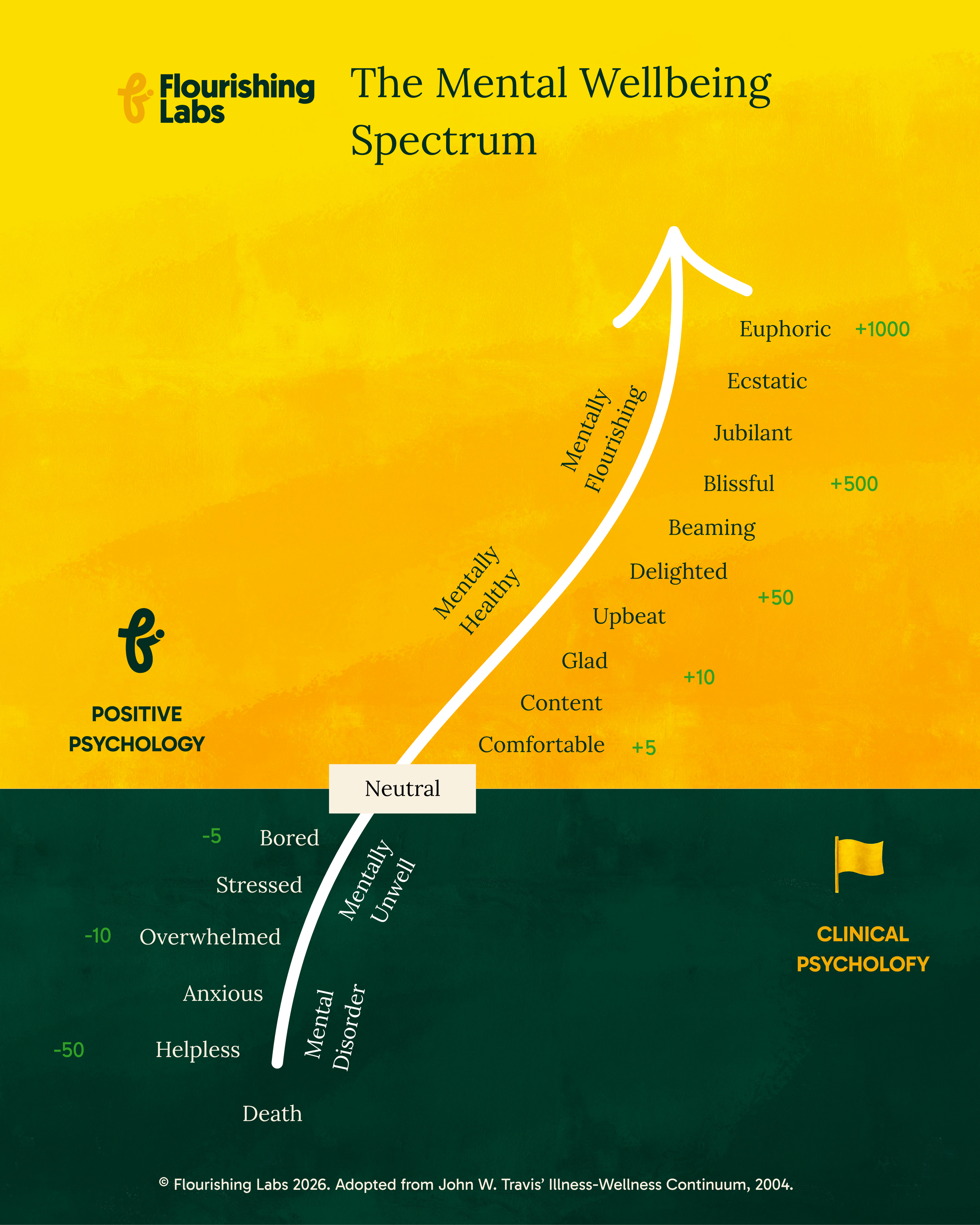
A really great way to explain what Positive Psychology does is through a Mental Wellbeing Spectrum as shown in the image above, adopted from Travis’ Illness-Wellness Continuum.
When you think about where you are in your life right now, where would you position yourself on this scale?
When you’re overwhelmed, Positive Psychology moves you from (-10) to (0).
Have you ever had an argument with a colleague that felt so triggering that it consumed your whole week?
We may normalise these as occupational hazards, but a string of these built up over many years, and you’re looking at a full-blown Anxiety Disorder. In the heat of the moment, Positive Psychology gives you tools to fend off negative emotions, like parsing your mind-chatter, talking back to harmful thoughts, and feeling at ease with vulnerability.
This helps you stay resilient, bounce back from adversity, and prevent mental illness in the long term.
When you’re languishing, Positive Psychology moves you from (-5) to (+10).
Have you ever felt like you’re just going through the motions but don’t really feel alive?
Just because you don’t have a mental illness doesn’t mean you’re mentally healthy and happy. You have a stable job, a roof over your head, and good people around you. Nothing is wrong, yet happy thoughts don’t come easily or often. I find this is often because people don’t have purposeful practices to notice the good and extract positive emotions from their experiences.
Positive Psychology builds habits like mindfulness, gratitude, and savouring that transforms everyday experiences into moments of delight and pleasure.
When you’re comfortable, Positive Psychology helps keep you there (0).
Have you ever wanted to make a big change but felt you lacked the energy to take the first step?
The modern world is draining. Even after a full night’s rest, by lunch time, your body battery can feel empty. Positive Psychology Practices like breathing, flow, and visualisation helps you recharge throughout your day.
This way, energy levels stay high, your mood remains stable, and you remain in a broadened state for creativity, problem-solving, and strategic work.
When you want to thrive, Positive Psychology moves you from (+50) to (+1000).
Are you at the top of your game, but still feel something is missing?
Our parents, schools, and organisations have a lot to answer for this. Social systems condition us to strive for financial, social, and career success with promises of peak happiness once attained. Do you feel that way right now? Paradoxically, Positive Psychology challenges you to try the mirror opposite:
Cultivating authentic & vulnerable connections over millions of nameless followers
Doing work that manifests your unique values and strengths versus chasing a status symbol (i.e. “I’m a Global Director at a FTSE 100 company with an office in the City”)
Being of service to humanity and the Earth over feeding one’s ambition
Through these practices, I feel so blissful and euphoric on most days - it’s unbelievable that it’s drug-free! I also marvel at how little effort or expense is required to feel these peak positive emotions. If you only have one life, you deserve to experience this +1000 feeling every day.
I hope this has given you a good overview of the benefits of Positive Psychology and how it can transform the way you think, feel, and behave everyday. Now that you know how powerful you are to determine your own health and happiness, try starting some practices this week to move up that arrow!
HOW to start being a Positive Psychology Practitioner today.
In 2011, at the American Psychological Association’s Annual Conference, Martin Seligman launched a moonshot goal for all humanity: 51% of the world’s population will be flourishing by 2051. Are you ready to be part of this challenge?
Some experiments for you to try this week:
Look at the Mental Wellbeing Spectrum again and be honest with yourself where you are right now.
Where do you want to be?
What’s one step you can take this week to pay more attention to how you feel as you go through your day?
The more attuned you are to what’s present in your body, the better you can deploy Positive Psychology Practices to address the delta.
References
Seligman, M. E. P. (2019). Positive psychology: A personal history. Annual Review of Clinical Psychology, 15, 1-23.
Travis, J. W. (2004). The new wellness workbook: How to achieve enduring health and vitality (3rd ed.). Celestial Arts.
Keyes, C. L. M. (2002). The mental health continuum: From languishing to flourishing in life. Journal of Health and Social Behavior, 43(2), 207-222.
Seligman, M. E. P. (2011). Flourish: A visionary new understanding of happiness and well-being. Free Press